
الرئيسية بلوق الصفحة 4

Elon Musk’s Most Notable Achievements: Shaping the Future Across Industries

0
Elon Musk achievements

Elon Musk is one of the most influential figures of our time, known for his relentless pursuit of groundbreaking ideas and his role in multiple industry-transforming ventures. His accomplishments span across industries like space exploration, electric vehicles, AI, and sustainable energy, creating waves and changing the way we think about technology, sustainability, and the future of humanity. Let’s dive into some of Elon Musk’s most significant achievements and explore how he continues to shape the future.

1. Zip2 Corporation: Musk’s First Success

In 1995, Elon Musk co-founded Zip2, a software company that provided business directories and maps for newspapers. This venture laid the groundwork for his career in tech and innovation. Compaq later acquired Zip2 in 1999 for almost $300 million, giving Musk his first substantial financial success and funding his future projects.


2. Co-Founding PayPal: Revolutionizing Online Payments

Musk’s next venture, X.com, was an online payment company that later became PayPal after merging with another company. With a mission to make online payments fast, easy, and secure, PayPal quickly gained traction and revolutionized the e-commerce industry. In 2002, eBay acquired PayPal for $1.5 billion, marking another financial milestone for Musk and establishing his reputation as an entrepreneur with a knack for industry disruption.


3. Founding SpaceX: Making Space Accessible

In 2002, Musk founded SpaceX (Space Exploration Technologies Corp.) with the ambitious goal of reducing space travel costs and making interplanetary exploration feasible. SpaceX’s most notable achievement came with the development of the Falcon 9, the world’s first reusable orbital rocket, which has drastically lowered the cost of space missions. The company’s collaboration with NASA and its successful missions to the ISS marked a new era in private spaceflight, setting a foundation for future Mars missions.


4. Tesla, Inc.: Leading the Electric Vehicle Revolution

Though Musk did not found Tesla, he joined the company early as an investor and chairman, later becoming CEO and transforming it into a global leader in electric vehicles. Tesla’s Model S, Model X, and the affordable Model 3 have made electric vehicles (EVs) mainstream, inspiring other automakers to follow suit. Musk’s strategy of using high-end models to fund the development of mass-market EVs has helped Tesla dominate the EV industry, positioning the company as a pioneer in sustainable transportation.


5. Advancing Reusable Rockets with SpaceX

SpaceX made history again in 2015 with the successful landing of its reusable Falcon 9 rocket. Reusability is crucial for cost-effective space exploration, and this technology has propelled SpaceX to become a leader in space tech. This breakthrough also set the stage for Starship, a fully reusable spacecraft designed for Mars missions, reinforcing Musk’s vision of making humans a multi-planetary species.


6. SolarCity and the Push for Sustainable Energy

In 2006, Musk co-founded SolarCity with a mission to make solar power accessible and affordable. SolarCity quickly became one of the largest solar energy providers in the United States, contributing to Musk’s goal of building a sustainable energy ecosystem. Tesla later acquired SolarCity, integrating solar energy products with Tesla’s electric vehicles and energy storage solutions to create a comprehensive clean energy system.


7. Hyperloop: A High-Speed Transportation Concept

In 2013, Musk introduced the Hyperloop, a concept for a high-speed, vacuum-based transportation system capable of moving passengers and cargo at unprecedented speeds. Although Musk hasn’t pursued the Hyperloop himself, his open-source approach inspired other companies to develop prototypes, aiming to transform public transportation and reduce travel time significantly.


8. Co-Founding OpenAI: Shaping the Future of Artificial Intelligence

In 2015, Musk co-founded OpenAI, an organization dedicated to advancing AI in a safe and ethical way. OpenAI’s research has led to breakthroughs in machine learning, including the development of large language models such as GPT. Musk’s involvement in OpenAI underscores his commitment to ensuring that AI technology benefits humanity without posing existential risks.


9. Neuralink: Merging Human Intelligence with Machines

Musk co-founded Neuralink in 2016 to develop brain-machine interface (BMI) technology, with the goal of addressing neurological conditions and eventually enabling humans to interact directly with computers. By connecting the human brain to AI systems, Musk envisions a future where humans can keep pace with AI advancements, making Neuralink a potential game-changer for medicine and technology.


10. The Boring Company: Solving Traffic Congestion

In 2016, Musk launched The Boring Company, aiming to reduce traffic congestion by creating underground tunnel networks for high-speed transportation. The company has developed test tunnels and is working on urban transportation projects in select cities, with a vision to transform urban mobility and make cities more efficient.


11. Tesla’s Contributions to Energy Storage

Tesla’s contributions to energy storage, including products like the Powerwall, Powerpack, and Megapack, are key in building a sustainable energy ecosystem. These battery systems store energy for homes, businesses, and utilities, facilitating the shift to renewable energy sources and reducing dependence on fossil fuels. Tesla’s energy storage solutions have become an integral part of renewable energy projects worldwide.


12. Starlink: Bringing Internet to Remote Areas

Starlink, a SpaceX initiative, aims to provide global high-speed internet through a constellation of low-Earth-orbit satellites. Operational in numerous countries, Starlink offers connectivity to remote and underserved areas, helping to bridge the digital divide. The project holds significant potential for global communication and emergency response.


13. First Private Company to Send Astronauts to the ISS

In 2020, SpaceX became the first private company to send NASA astronauts to the International Space Station, a milestone in commercial space exploration. This achievement signaled the beginning of private-public partnerships in space and highlighted SpaceX’s role as a leader in aerospace technology.


14. Becoming the World’s Richest Person

In 2021, Musk became the world’s richest person, a testament to his success and influence across various industries. His wealth and the companies he leads underscore the impact he has had on technology and the economy, with a legacy that extends beyond his financial success.


15. Acquiring Twitter and Rebranding as X

In 2022, Musk acquired Twitter and rebranded it as “X,” making sweeping changes to the platform’s moderation policies, subscription model, and business operations. This move stirred significant discussions on free speech and social media’s role in modern communication, showcasing Musk’s willingness to take bold actions that spark debate and redefine industries.


Conclusion

Elon Musk’s achievements highlight his vision of transforming the world through innovation and sustainable technology. From revolutionizing the electric vehicle market and pioneering private space travel to advancing AI and reshaping urban transportation, Musk’s ventures aim to tackle humanity’s biggest challenges. His relentless pursuit of ambitious goals continues to redefine industries and inspire a future where technology meets sustainability and exploration meets reality. As Musk’s journey unfolds, the impact of his achievements will likely be felt for generations.

Read also: Best Freelancing Website 2023
Apple’s Q4 2024 Earnings: Revenue Boosted by iPhone Sales, Sets New September Record

0

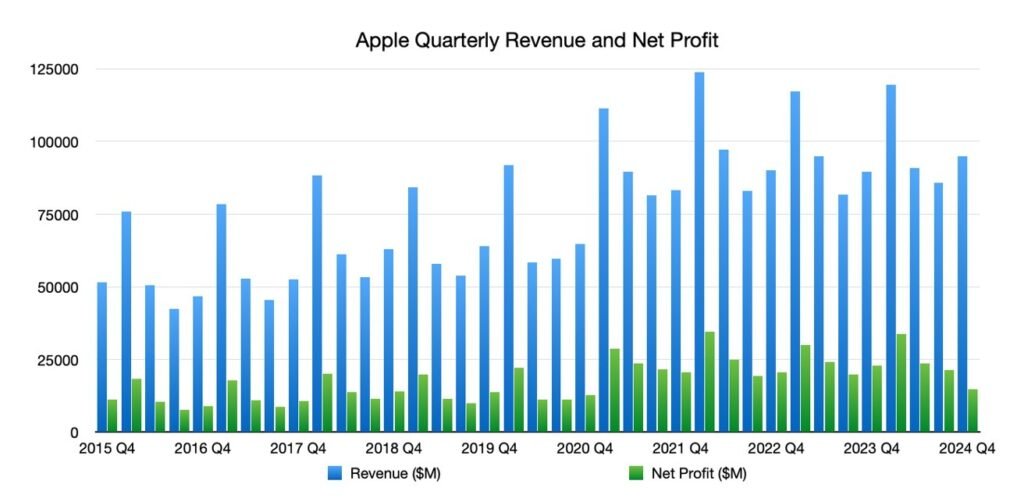
Apple’s fourth-quarter earnings for 2024 reveal a record revenue of $94.93 billion, beating Wall Street projections primarily due to robust iPhone sales. Covering the fiscal period ending in September, the report also provides Apple’s annual performance insights.

For Q4, Apple reported $94.93 billion in revenue, up from $89.5 billion in the same quarter last year, with an earnings per share (EPS) of $1.64. Wall Street had predicted $94.4 billion in revenue and an EPS of $1.55, marking a clear outperformance by Apple.

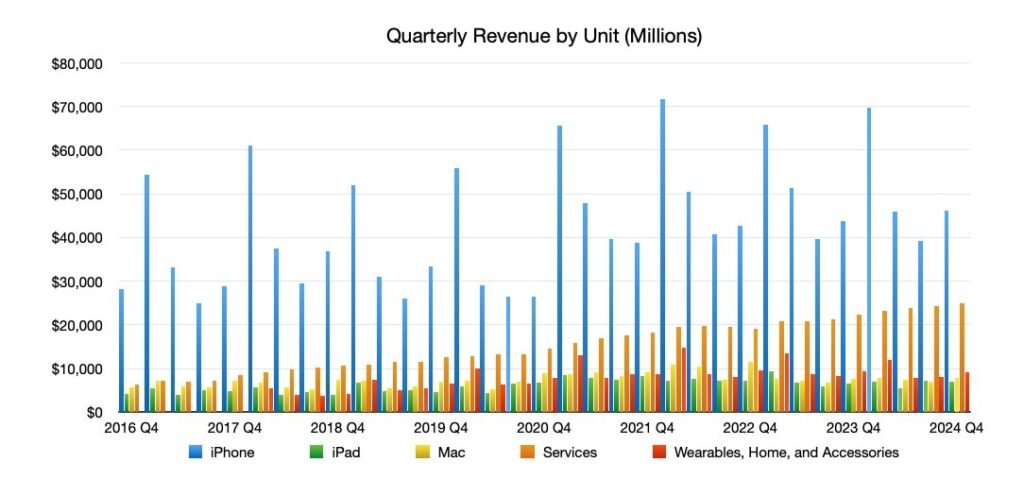
Revenue for iPhone sales reached $46.22 billion, a 5.5% increase from $43.8 billion in Q4 2023. iPad sales rose 7.9% to $6.95 billion, and Mac revenue increased slightly by 1.7% to $7.74 billion. Apple’s Services segment, known for steady growth, rose 11.9%, reaching $24.7 billion from $22.3 billion a year ago. However, Wearables, Home, and Accessories saw a slight decline, falling 3% to $9.04 billion.

New product releases in the quarter—such as the iPhone 16 series, AirPods Max with USB-C, Apple Watch Series 10, and the new Apple Watch Ultra 2—are expected to impact Q1 2025 earnings more significantly as they launched near the end of Q4. On the other hand, Q3’s launches, including the M4-powered iPad Pro, M2 iPad Air, and Apple Pencil Pro, will more substantially contribute to Apple’s future revenue.

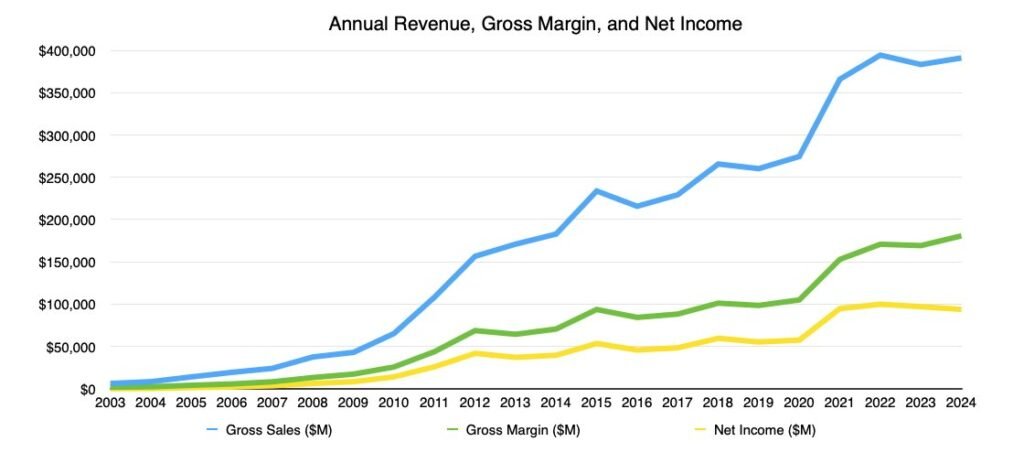
Apple’s full-year revenue for 2024 reached $391 billion, up from $383.3 billion in 2023, with a gross margin of $180.7 billion.

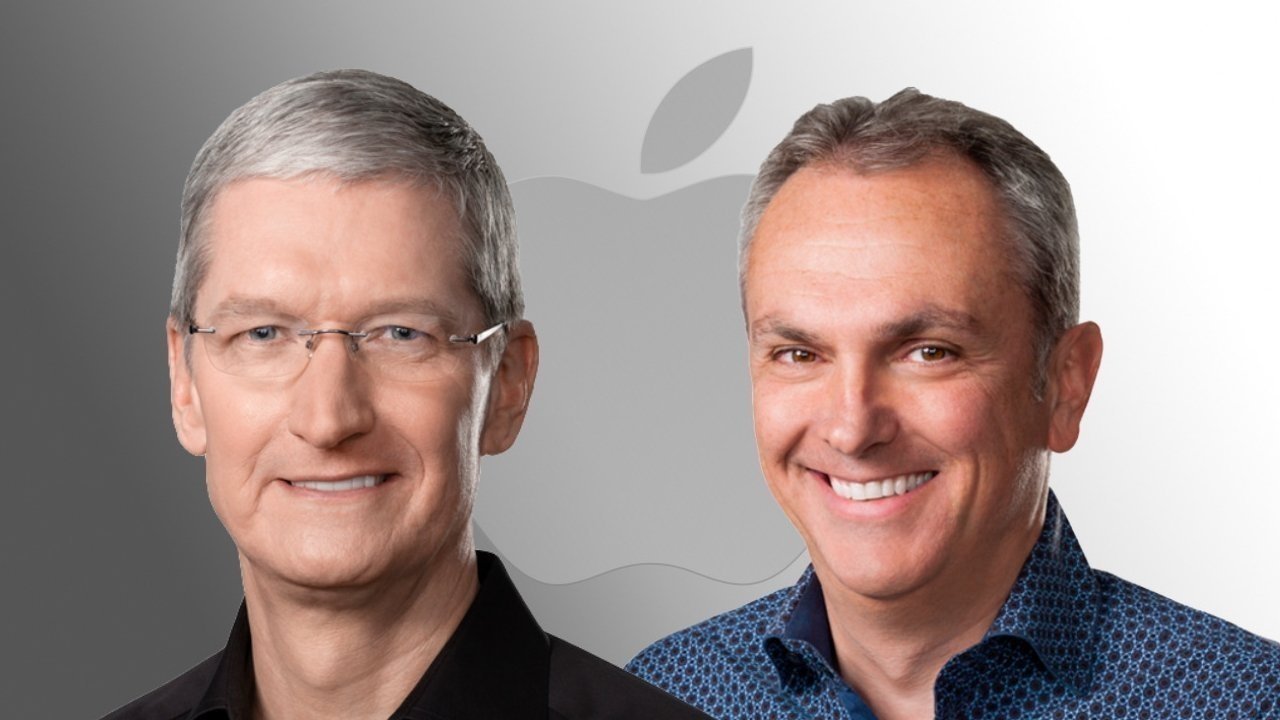
This quarter marked CFO Luca Maestri’s final earnings call before stepping down in January, when VP of Financial Planning and Analysis, Kevan Parekh, will take over. CEO Tim Cook commented, “Today, Apple is reporting a new September quarter revenue record of $94.9 billion, up 6 percent from a year ago.” Maestri added, “Our performance generated nearly $27 billion in operating cash flow, allowing us to return over $29 billion to our shareholders.”

The outgoing CFO noted Apple’s growing active installed base across all product categories, underscoring the company’s success in building customer satisfaction and loyalty across the globe.

Apple Q4 2024 earnings

Source: Apple Insider

Read also: M3 MacBook Air Now Includes 16GB Unified Memory at $999 Entry-Level Price

M3 MacBook Air Now Includes 16GB Unified Memory at $999 Entry-Level Price

1
M3 MacBook Air 16GB unified memory

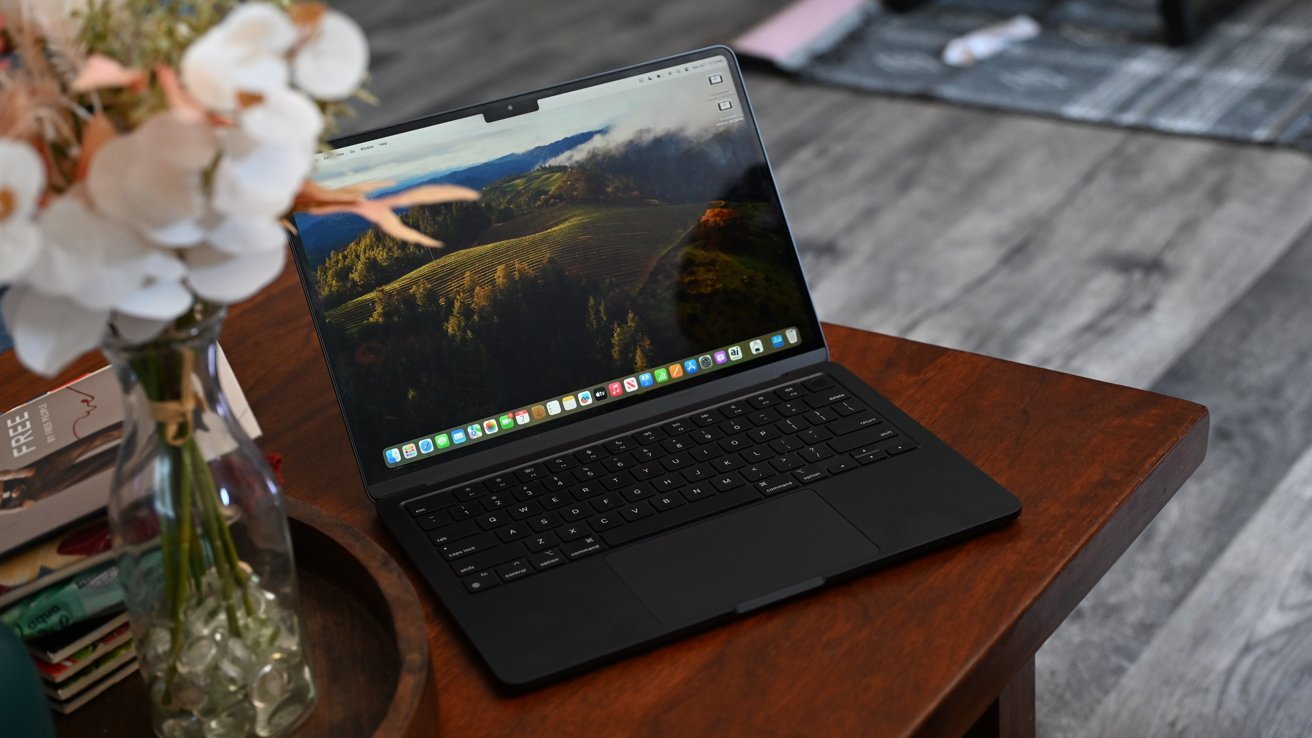
The base model of Apple’s M3 MacBook Air now offers 16GB of unified memory, doubling its previous capacity while maintaining its $999 price tag. Alongside the release of the new M4 MacBook Pro, Apple has enhanced the MacBook Air lineup, with both the M2 and M3 versions now featuring 16GB in the entry-level model.

This change brings a meaningful upgrade to the MacBook Air, Apple’s affordable alternative to the MacBook Pro. Previously, upgrading to 16GB cost an additional $200, raising the price to $1,299—significantly closer to the $1,599 base price of the MacBook Pro.

The MacBook Air last received an update in March 2024, when Apple introduced a design that mirrors the MacBook Pro. AppleInsider hailed it as the “best Mac for nearly everyone” just three months after its release.

Source: Apple Insider

Read more like: Apple Launches M4-Powered MacBook Pro Models in Space Black

Apple Launches M4-Powered MacBook Pro Models in Space Black

1
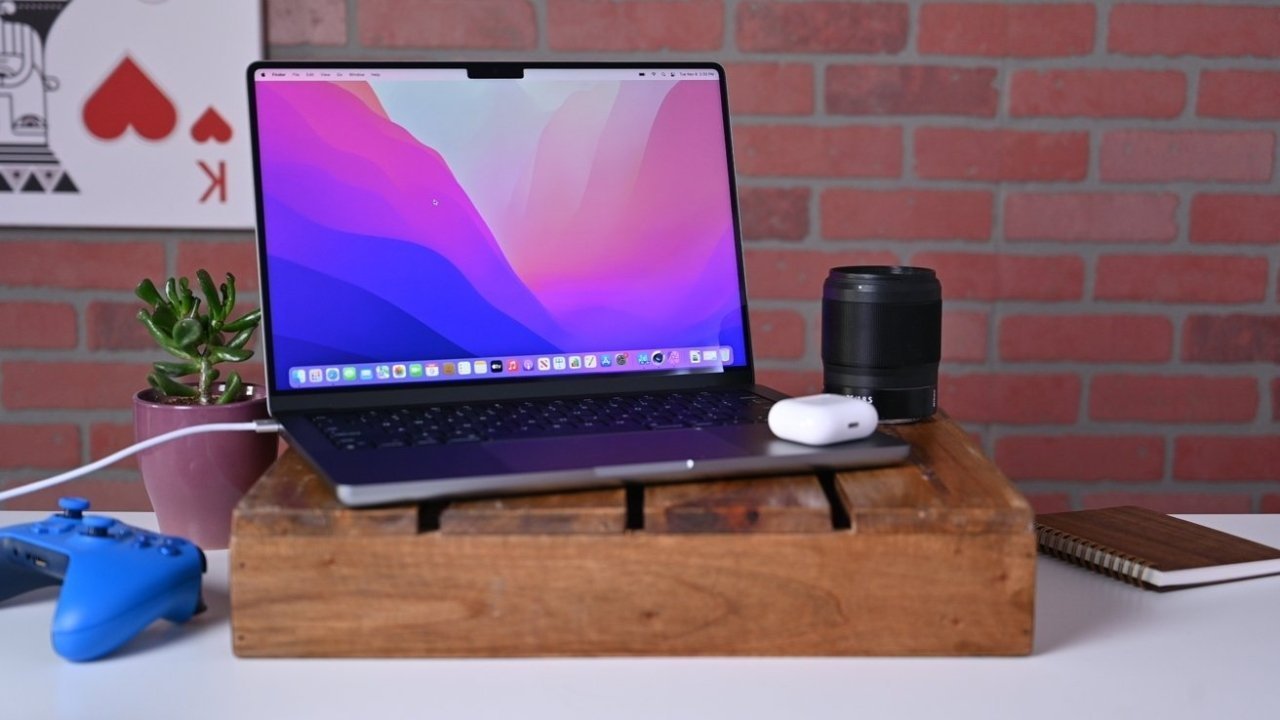
M4 MacBook Pro

Apple has released its latest MacBook Pro models, powered by upgraded M4 chips, now available in M4, M4 Pro, and M4 Max variations. The updated 14-inch and 16-inch MacBook Pro join the iPad Pro in adopting the M4 series, with a powerful new Space Black color option available for a sleek look.

Central to the upgrade is the M4 chip, bringing notable improvements for both single-core and multi-core tasks compared to its M3 predecessor. Expanding on this, Apple now offers the M4 Pro and M4 Max models, both built to cater to varying levels of professional performance.

The M4 features a 10-core CPU (four performance and six efficiency cores) and a 10-core GPU, while the M4 Pro ramps up with options for a 12-core CPU (eight performance cores) and 16-core GPU, or a 14-core CPU with a 20-core GPU. The high-end M4 Max steps it up further with a 14-core CPU with a 32-core GPU, or an optional 16-core CPU paired with a 40-core GPU.

Memory bandwidth also scales with each chip version: the M4 offers 120GB/s, the M4 Pro reaches 273GB/s, and the M4 Max hits up to 546GB/s, depending on configuration.

Although the core hardware is revamped, the MacBook Pro retains familiar elements such as the 14.2-inch and 16.2-inch Liquid Retina XDR displays. These mini-LED screens deliver peak brightness of 1,600 nits for HDR content and support True Tone, ProMotion, and Wide Color (P3).

On the connectivity front, M4 Pro and M4 Max models feature three Thunderbolt 5 ports, while the M4 model utilizes Thunderbolt 4. All models include MagSafe 3, HDMI, SDXC card slots, Wi-Fi 6E, and Bluetooth 5.3.

Enhanced by a six-speaker audio system, Spatial Audio support, and a suite of studio-quality mics with directional beamforming, these updates ensure the new MacBook Pro series delivers immersive experiences across audio and video.

The new M4 MacBook Pro lineup is available for preorder and will begin shipping on November 8. Pricing starts at $1,599 for the 14-inch and $2,499 for the 16-inch model.

How to Use Apple’s New Text Effects in iOS 18 Messages

0
iOS 18 text effects in Messages

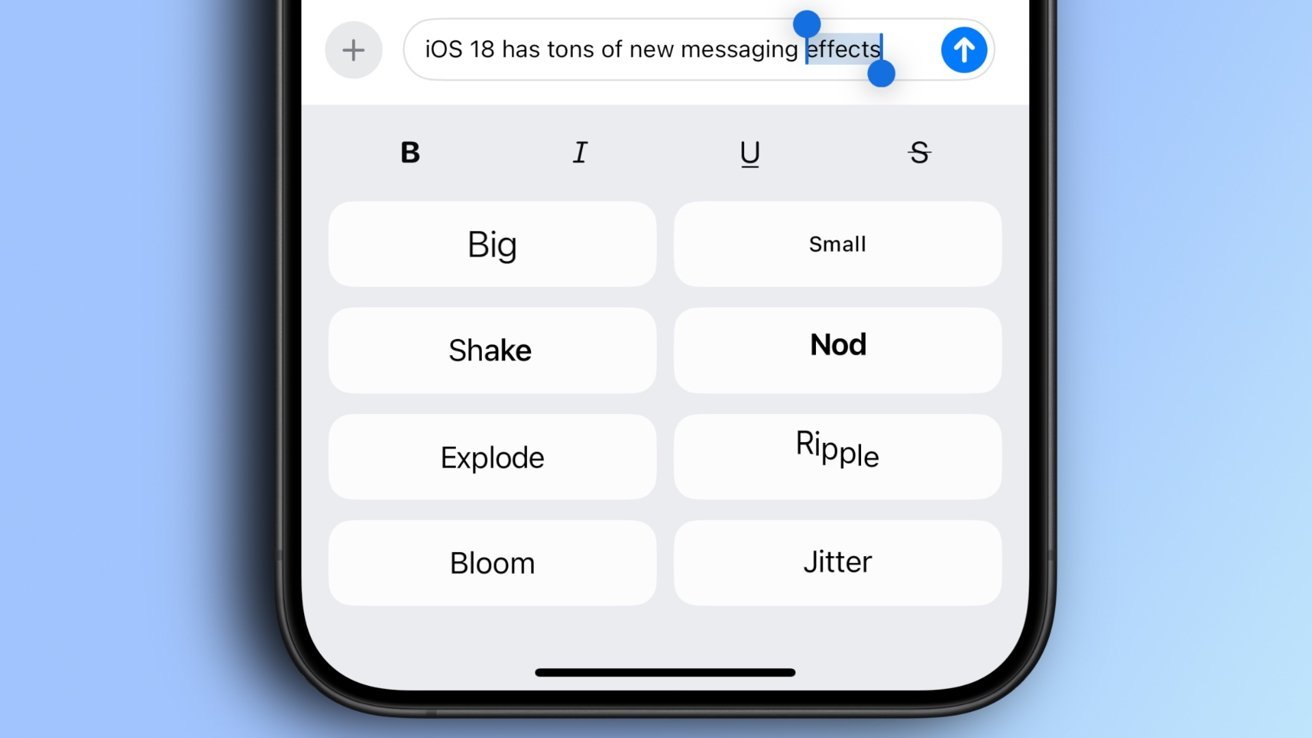
Apple’s iOS 18 update has brought exciting new features to iPhone users, including an upgrade to the Messages app. With the addition of animated text effects, iPhone users now have creative ways to express themselves with ease. These new text effects can animate specific words, adding emphasis with options like explosions for impact or a jitter to show excitement or nerves.

There are eight fresh effects to choose from, available to anyone with iOS 18 or later. To view the effects, your recipient will also need iOS 18, iPadOS 18, or macOS 15 Sequoia. And keep in mind, these effects only work with iMessages, not SMS or RCS.

How to Add Text Effects in Messages on iOS 18

Applying a text effect in Messages is simple and can be done while you type or after you’ve finished. Here’s how:

  1. Type your message.
  2. Double-tap the word(s) you want to animate.
  3. Tap the “A” icon on the suggestions bar above your keyboard.
  4. Choose your desired animation effect.

Alternatively, you can select “Text Effects” from the pop-up menu (where options like “Copy” appear) after highlighting the text. To exit the effects list without choosing one, simply tap back on the text.

Once you’ve chosen an effect, you’ll see a preview animation before sending, allowing you to perfect your message’s look.

The iOS 18 update, launched in September 2024, includes more than just Messages enhancements, featuring new Home Screen customizations, an overhauled Control Center, and a revamped Photos app. The update also sets the stage for iOS 18.1, which brings advanced Apple Intelligence features to iPhone.

Read more: Amazon Listing Leaks Specs of Unannounced M4 Mac Mini Model in Comparison Chart

Source: Apple insider

Amazon Listing Leaks Specs of Unannounced M4 Mac Mini Model in Comparison Chart

1
Amazon leaks unannounced M4 Mac Mini specs

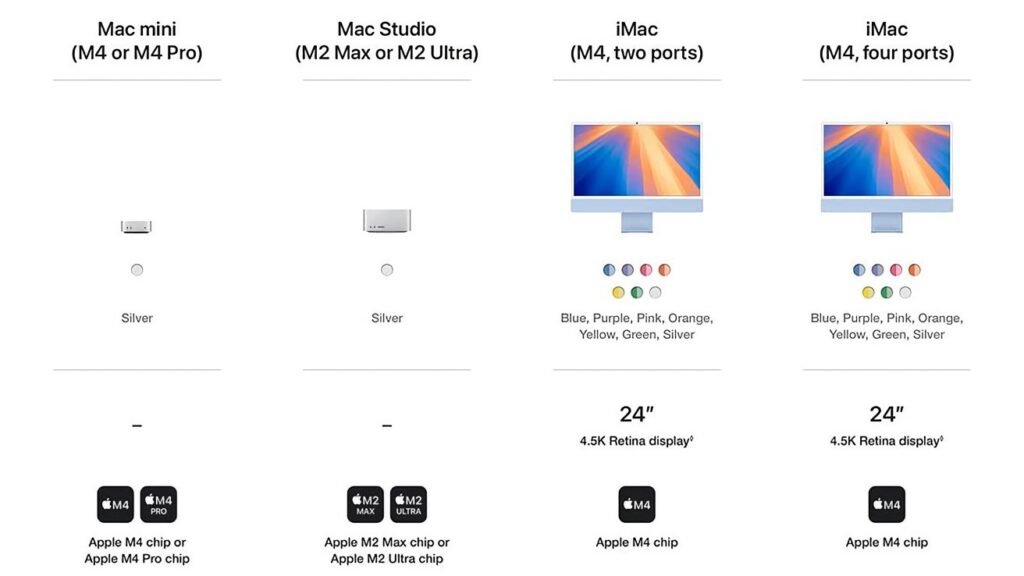
An Amazon listing for Apple’s 24-inch iMac briefly featured a comparison chart, now removed, that revealed an unannounced version of the Mac mini with M4 and M4 Pro chip options. Although Apple’s staggered announcement schedule usually keeps the spotlight on new products, this unexpected Amazon leak may have disrupted that strategy.

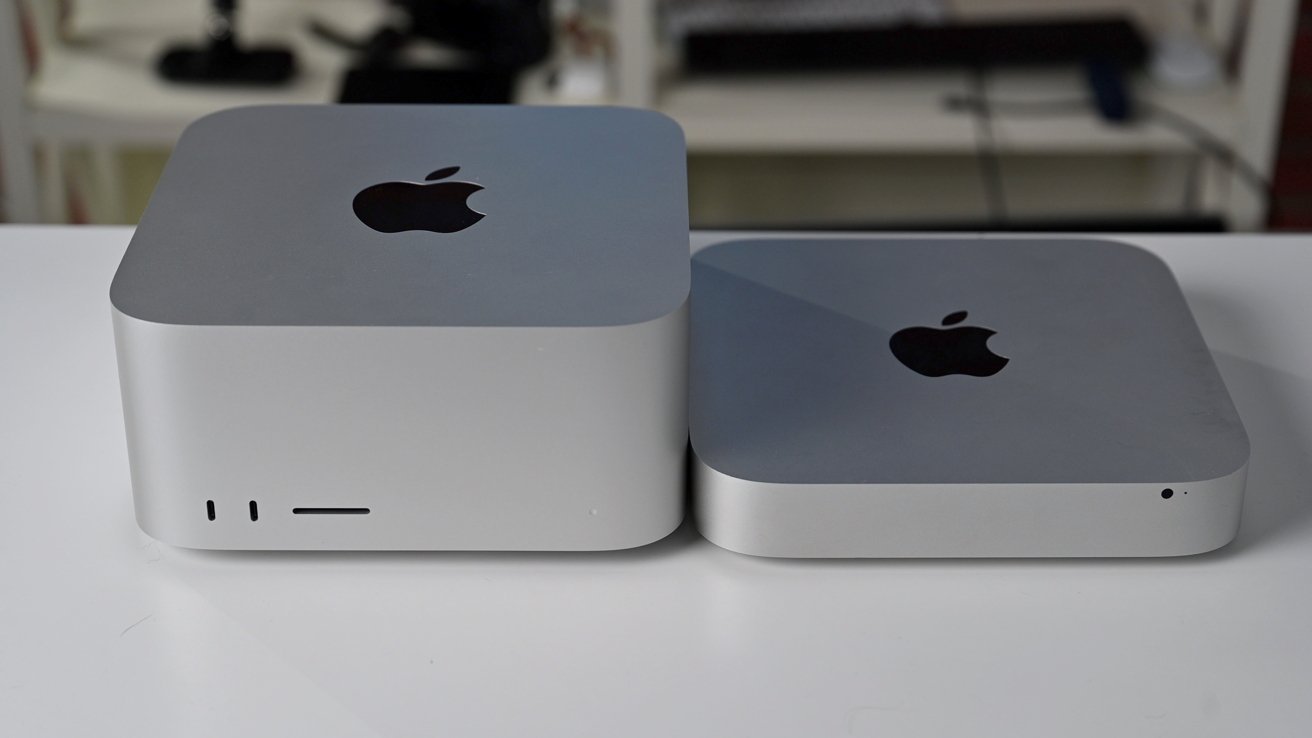
The comparison chart, first spotted by MacRumors, included a thumbnail image of a compact, Mac Studio-like device speculated to be the new Mac mini, configurable with up to 14-core CPU, 20-core GPU, 64GB RAM, and 8TB of storage. Only the silver finish is currently offered.

Interestingly, the design appears similar to the Mac Studio but more compact, possibly even closer to the dimensions of an Apple TV device. The front view hints at USB ports and an indicator light, though lacks the SD card slot seen on the Mac Studio.

Apple’s announcement week continues, with an anticipated unveiling of updated MacBook Pros featuring M4 chips on Tuesday, followed by the official introduction of the redesigned Mac mini on Wednesday.

Source: Apple Insider

Read also: One Month with iOS 18.1 and iPadOS 18.1: Apple Intelligence and Its Impact

One Month with iOS 18.1 and iPadOS 18.1: Apple Intelligence and Its Impact

1
Apple Intelligence in iOS 18.1 and iPadOS 18.1

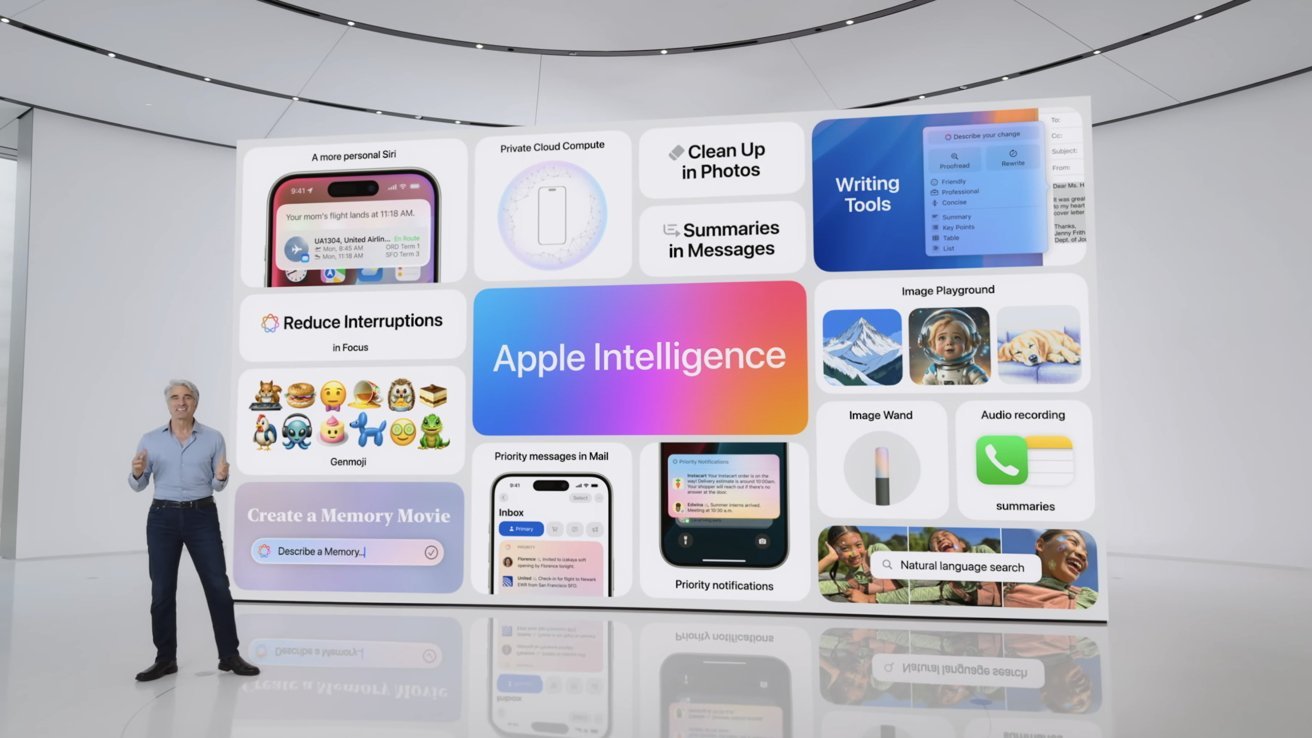
Apple’s rollout of “Apple Intelligence” arrived a month into iOS 18 and iPadOS 18, marking a new phase for Apple’s AI on iPhones and iPads. While the tech world often adopts the latest AI breakthroughs to stay competitive, Apple remains conservative, rarely among the first to release new AI features. This cautious approach continues with Apple Intelligence, a tool for writing, summarizing, and photo editing that favors user privacy and data security over revolutionary AI capabilities.

A Closer Look at Apple Intelligence in iOS 18.1 and iPadOS 18.1

Apple Intelligence brings AI integration across various apps and system functions but isn’t the leap many users might expect. Rather than a transformative AI assistant, Apple Intelligence offers an array of tools built on large language models. Unlike competitors’ cloud-based models, Apple’s is largely on-device, ensuring data privacy through technologies like Private Cloud Compute.

1. Writing Tools for Everyday Use

Writing Tools in Apple Intelligence provide system-wide text editing options, like proofreading and sentence rewrites, making them accessible across apps. I found the Proofread tool particularly handy—it quickly replaced my need for third-party grammar tools and integrates seamlessly with Apple Notes. However, Apple Intelligence occasionally produces “hallucinations,” where certain terms are inaccurately interpreted, a known limitation of many AI systems.

2. System-Wide Summaries for Enhanced Notifications and Content Review

Apple Intelligence’s summary features organize notifications, emails, and even Safari content, providing users with succinct previews. Lock screen notifications now include summary text, which groups messages by app and topic, though humor and nuance can sometimes be lost. In emails, the summary feature allows for a quick overview, while Safari’s Reader Mode includes generated summaries and a table of contents. These tools streamline daily tasks and provide useful insights into messages, emails, and web pages.

3. Enhanced Photo Organization and Editing

Apple Photos benefits from Apple Intelligence’s new search, memory generation, and cleanup tools. Searching by descriptive terms, like “sunset at the beach,” brings up relevant images through natural language processing, and custom memory movies offer flexible ways to relive moments. Cleanup tools are useful, although not groundbreaking, with options like pixelating faces and removing objects—a helpful addition but far from revolutionary.

What’s New in Siri with iOS 18.1?

The Siri update with iOS 18.1 and iPadOS 18.1 includes an updated animation, a shortcut for Type to Siri, and improved self-correction for commands. Unfortunately, users hoping for advanced Siri improvements may be disappointed, as this update provides mostly aesthetic enhancements. Future updates are expected to increase Siri’s contextual capabilities and integrate with app intents, potentially allowing users to pull data from various apps by early 2025.

Addressing the Gap Between AI Expectations and Reality

While AI advancements often fuel public excitement, Apple’s cautious approach keeps expectations grounded. Google and OpenAI continue to release early-stage features that are highly marketed but not always practical, which is where Apple’s strategy differs. Apple Intelligence’s focus is on private, device-based enhancements that improve user workflows, rather than flashy AI features.

One Month In: Is iOS 18.1 and iPadOS 18.1 Worth the Hype?

Beyond Apple Intelligence, iOS 18.1 and iPadOS 18.1 bring welcome updates, like dark mode customization on the Home Screen, a redesigned Control Center, and the Passwords app. However, iPadOS still faces persistent bugs with Stage Manager, and Siri’s core functionality has seen minimal enhancement. Despite these limitations, Apple Intelligence’s addition of Writing Tools and system-wide summaries has positively impacted daily workflows.

Apple’s cautious approach to AI may seem underwhelming at first, but the integration of Apple Intelligence adds functional enhancements while preserving data privacy. As Apple continues refining its approach, users can look forward to more privacy-first updates.

Read also: Apple Launches 24-inch iMac with M4 Chip – Enhanced Performance and Updated Features

Source: appleinsider

M4 24-inch iMac vs. M1 24-inch iMac: Is It Worth the Upgrade?

0
M4 24-inch iMac vs M1 iMac

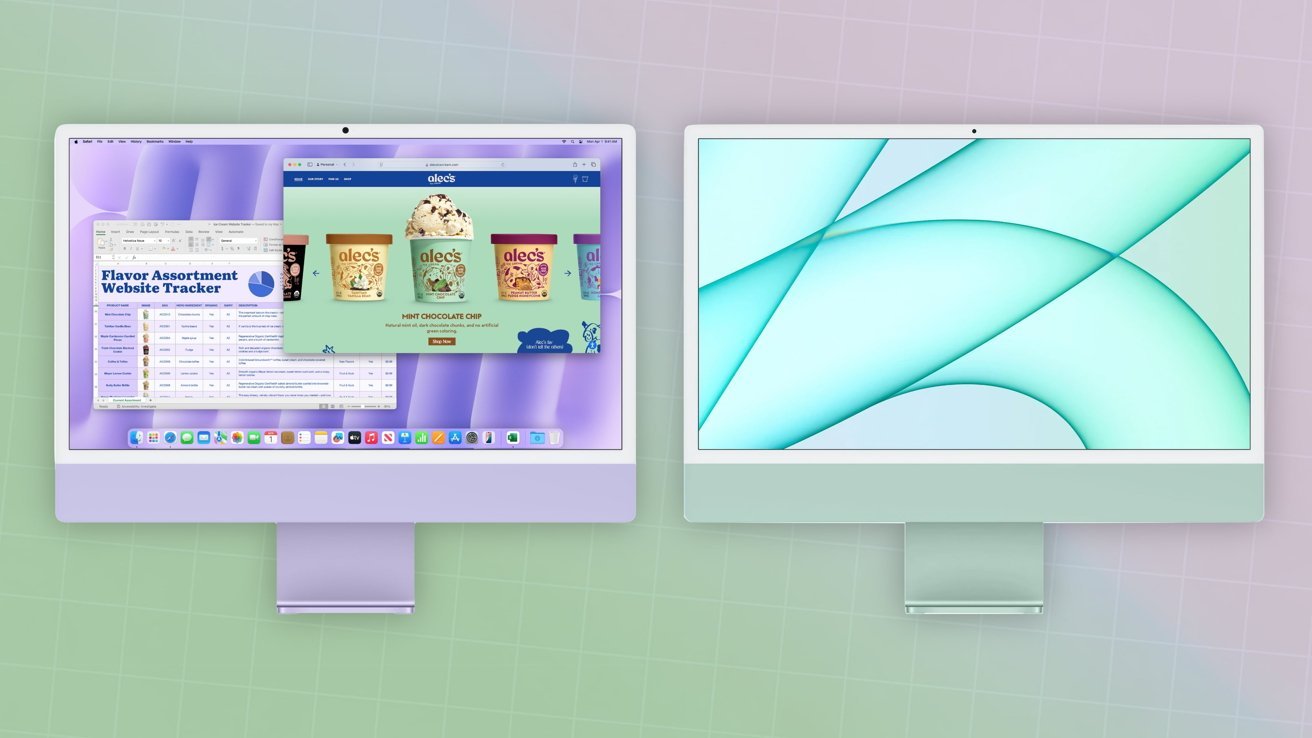
Apple recently introduced the updated 24-inch iMac with the M4 chip, marking the third version of its all-in-one desktop since the M1’s debut in April 2021. After three and a half years, original M1 iMac users may wonder if the M4’s performance enhancements make this a worthy upgrade.

Specifications: M4 vs M1
The new M4 iMac boasts configurations including 8-core and 10-core CPUs, offering significantly more memory bandwidth and faster graphics. Compared to the M1’s 66.67GB/s, the M4 delivers 120GB/s, supporting memory options up to 32GB. Apple claims the M4’s CPU is up to 1.7 times faster, with double the graphics power—an attractive boost for creative and multitasking workflows.

Design and Display
Both models maintain the sleek 24-inch 4.5K Retina display, though the M4 introduces optional Nano-texture glass to reduce glare, enhancing screen usability in bright spaces. While weight and size remain nearly identical, small changes such as Bluetooth 5.3 and Wi-Fi 6E support improve connectivity for modern network demands.

Camera and Audio Enhancements
The M4 iMac upgrades to a 12MP Center Stage camera, providing enhanced image quality and new features like Desk View for iPhone integration. Additionally, the high-impedance headphone jack will appeal to audiophiles seeking superior sound.

Pricing and Customization
Pricing starts at $1,299, consistent with the M1’s original release, while additional memory, storage, and customization options can increase the cost. The M4 introduces new options like Nano-texture glass and expanded RAM configurations, providing more flexibility for performance-driven users.

Should You Upgrade?
For M1 iMac users, the M4 offers notable enhancements, but it may not be enough for those content with the original model’s performance. However, new buyers will find the M4 to be a robust choice, balancing powerful performance with modern features for an all-in-one experience.

Source: Apple Insider

Read also: Apple Launches 24-inch iMac with M4 Chip – Enhanced Performance and Updated Features

Apple Launches 24-inch iMac with M4 Chip – Enhanced Performance and Updated Features

2
24-inch iMac with M4 chip

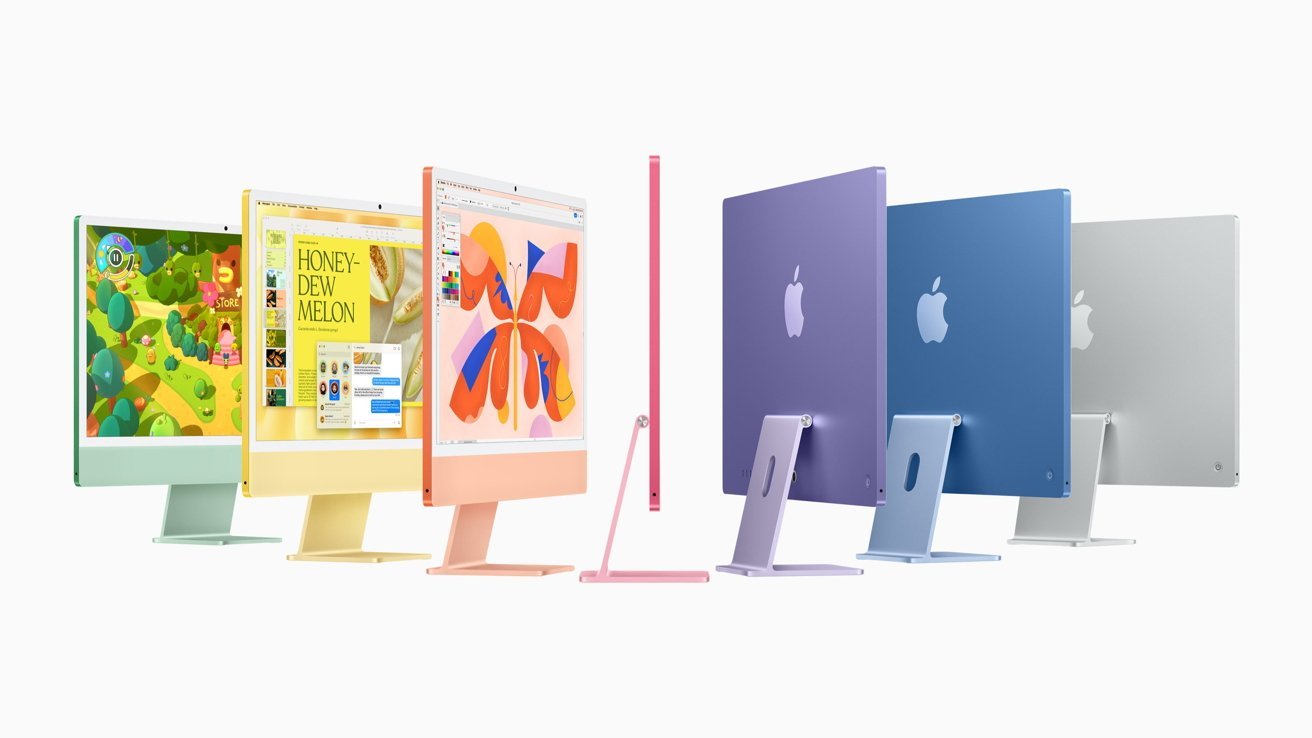
Apple has refreshed its 24-inch iMac, equipping it with the new M4 chip to significantly enhance performance. Part of Apple’s latest Mac lineup, the upgraded iMac retains its sleek design but delivers powerful improvements.

The updated model replaces the previous M3 chip with the M4, which Apple claims has the world’s fastest CPU core, offering up to 1.7x the performance of the M1 iMac. Graphics capabilities are also boosted, with a 2.1x improvement for gaming and photo editing over the M1 version.

Two configurations of the M4 iMac are available, one with an 8-core CPU and 8-core GPU, and another with 10-core versions. The base memory is upgraded to 16GB of unified memory, expandable up to 32GB. Storage begins at 256GB, with options up to 2TB.

The iMac’s vibrant 24-inch 4.5K Retina display returns, offering 500 nits brightness, Wide Color (P3), True Tone, and now a nano-texture glass option to reduce reflections for clearer visuals.

A 1080p FaceTime HD camera sits above the screen, supported by an advanced image processor for high-quality video calls. The iMac’s audio features a six-speaker system with force-canceling woofers and Spatial Audio with Dolby Atmos, plus a studio-quality three-mic array for excellent sound capture.

Ports include two Thunderbolt connections with support for up to four, plus a 3.5mm headphone jack. The iMac also supports Bluetooth 5.3, Wi-Fi 6E, and Gigabit Ethernet integrated into the power adapter to keep the minimalist look intact.

Starting at $1,299, the new 24-inch iMac with M4 is available for pre-order, with shipping beginning on November 8.

Apple Introduces USB-C Magic Accessories with M4 iMac Preorders

0
USB-C Magic Accessories

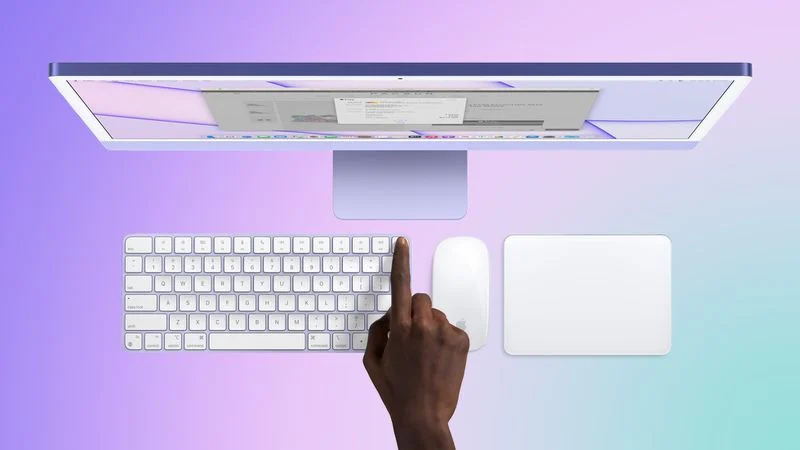
Apple has introduced updated Magic Keyboard, Mouse, and Trackpad accessories, all now featuring USB-C ports. These redesigned accessories also debut alongside the new M4 iMac, available in seven vibrant colors and set to start shipping on November 8.

With the M4 iMac, Apple offers color-matched Magic Keyboards, with options including a standard model or an upgraded version with Touch ID and a numeric keypad for an additional $80. Color-matched Magic Mouse and Magic Trackpad options are also available; selecting the Trackpad adds $50 to the total cost.

This USB-C update aligns with the European Union’s regulations requiring standardized chargers across consumer electronics by 2024. Each M4 iMac will also include a matching USB-C power cable for charging accessories and a color-coordinated power cord.

Standalone purchases of these updated Magic accessories are also available in classic white or black. The new Magic Keyboard with Touch ID and numeric keypad is priced at $199, the Magic Trackpad at $149, and the Magic Mouse at $99. Shipments for standalone accessories are expected to begin October 31.

Note that Apple currently offers these color-matched accessories only when purchasing a new iMac, without an option to mix both the Magic Mouse and Trackpad selections together in the same order.