
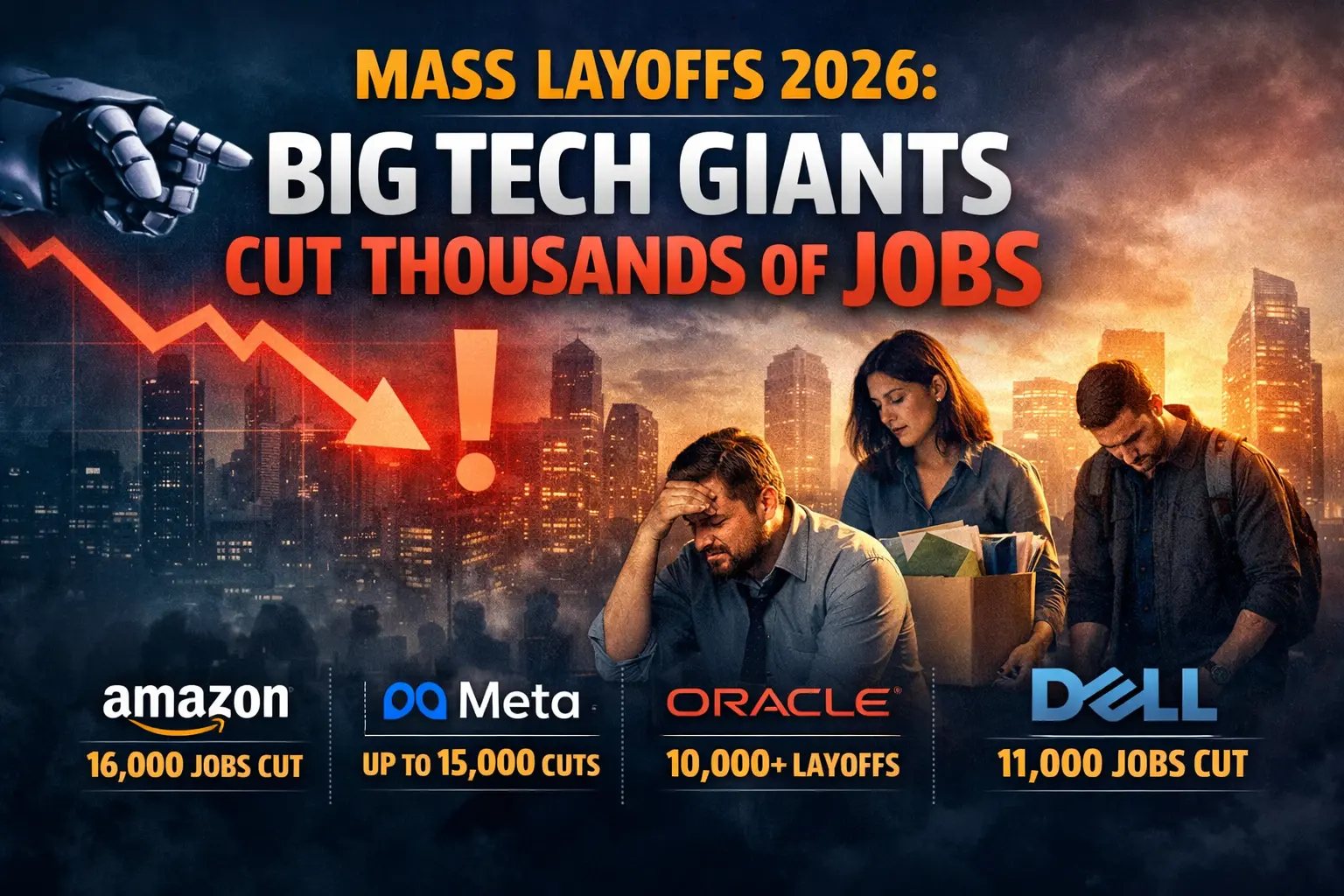
Major Company Job Cuts in 2026: Every Layoff, Every Stat
It's April 2026, and we're already at 90,000 jobs cut. Amazon, Oracle, Meta, UPS—some of the world's largest companies, all cutting simultaneously. But here's what makes this year different from past layoff cycles: companies aren't pretending they over-hired. They're saying AI tools let them do the same work with smaller teams. That's a permanent shift, not a temporary correction.
The reasons vary. Some companies are genuinely replacing jobs with AI. Others are using AI as cover to cut middle management layers—org charts got bloated during the hiring boom, now they're thinning them out. And some sectors are just facing shrinking demand and have to cut to protect short-term profits.
Whatever the reason, the pace is brutal:
And it’s accelerating.
Why Are Companies Cutting Jobs?
AI is replacing actual job functions. Block cut 40% of staff. Meta, Oracle, and Amazon all said smaller teams with AI tools can match or exceed what bigger teams used to do. It's not rhetoric anymore—it's happening.
Middle management bloat is getting cut. Tech companies hire like crazy, build thick org charts, then realize half the management layers aren't adding value. Amazon's 16,000 cut? Mostly corporate and management roles that were redundant. Flattening organizations is a real thing, and it's painful for middle managers.
Some industries are just hurting. Gaming revenue is down. Consumer goods facing weak demand. Energy companies restructuring. These layoffs aren't about AI—they're about simple economics. Revenue drops, payroll gets cut. It's ugly but straightforward.
"Intelligence tools have changed what it means to build and run a company. A significantly smaller team, using the tools we're building, can do more and do it better." — Jack Dorsey, CEO of Block, February 2026
The Major Job Cuts: Full Tracker
| Company | Sector | Jobs Cut | % of Workforce | Reason |
|---|---|---|---|---|
| Amazon | E-Commerce / Cloud | 16,000 | ~4.6% of corp. staff | Restructuring AI Efficiency |
| Oracle | Enterprise Software | ~30,000 | ~18% of workforce | AI Infrastructure Cost Cutting |
| UPS | Logistics / Delivery | ~30,000 | Operational roles | Restructuring Automation |
| Dell Technologies | Hardware / Enterprise | ~11,000 | ~10% of workforce | AI Pivot Cost Reduction |
| Chevron | Energy / Oil & Gas | 8,000 | 15–20% of workforce | Cost Simplification M&A |
| Heineken | Consumer Goods | 6,000 | ~7% of workforce | Weak Demand Profit Pressure |
| Block (Square / Cash App) | Fintech / Payments | 4,000 | 40% of workforce | AI Overhaul |
| Dow Chemical | Manufacturing | 4,500 | ~13% of workforce | AI & Automation Restructuring |
| Meta Platforms | Social Media / AI / VR | 1,500+ | Up to 20% planned | AI Reinvestment Metaverse Exit |
| Atlassian | Enterprise Software | 1,600 | ~10% of workforce | AI Investment |
| Morgan Stanley | Financial Services | 2,500 | ~3% of workforce | Cost Optimization Division Consolidation |
| Mastercard | Fintech / Payments | ~1,400 | ~4% of workforce | Strategic Pivot |
| Epic Games | Gaming | 1,000 | ~20% of workforce | Declining Revenue |
| Social Media | ~780 | <15% of workforce | AI-Forward Strategy | |
| eBay | E-Commerce | 800 | ~6% of workforce | Streamlining |
| Target | Retail | 500 | Corporate roles | Reorganization |
Cuts by Industry: Who's Taking the Biggest Hit?
Tech and logistics lead the numbers, but this isn't a tech-only story anymore. Layoffs are spreading across energy, finance, consumer goods, and media—a sign that companies everywhere are reassessing their workforce needs.
How It Unfolded: A Month-by-Month Timeline
Amazon announces 16,000 corporate cuts. Pinterest, Meta (Reality Labs), and UPS follow with their own reductions. January layoff announcements hit their highest level since 2009.
Block announces its landmark 40% workforce cut. Heineken, Washington Post, Morgan Stanley, Mastercard, and Dow Chemical all reveal major reductions. Over 45,000 total tech jobs are gone by end of month.
Atlassian cuts 10% (1,600 roles). CBS News closes its radio division. Target announces 500 corporate cuts. Epic Games confirms 1,000 Fortnite-related layoffs. Peloton cuts 11% to save $100M.
Oracle sends a 6 a.m. email to up to 30,000 workers across the US, Canada, Mexico, and India. The largest single layoff event of 2026. Total losses now exceed 90,000.
The Bigger Picture: So What's Actually Happening?
Last year, 1.1 million Americans lost their jobs. This year could be worse. At the current pace—963 jobs per day—we're on track to lose more tech jobs in 2026 alone than all of last year combined.
The pain is geographically concentrated. Seattle is getting hit hardest. Amazon and Microsoft cut roughly 16,590 tech jobs combined in the first quarter. San Francisco lost about 9,395. These cities built entire ecosystems around tech employment. Local restaurants, startups, apartments—all dependent on that wage base. When 16,000 Amazon employees lose income, the whole city feels it.
Here's the darkest part: the companies cutting jobs are making more money than ever. Amazon did $716.9 billion in revenue last year—best year ever—then cut 16,000 people anyway. Meta is spending $135 billion on AI in 2026, nearly double last year's spend, while planning to cut 15,000-20% of staff. They're not cutting to survive. They're cutting to optimize profit margins.
Of U.S. hiring managers surveyed in 2026, 55% expect further layoffs at their own companies this year, and 44% identify AI as the primary driver. — Resume.org survey, 2026
What This Means If You Work in Tech
There's a clear split happening. OpenAI, Anthropic, xAI—companies building the AI itself—they're still hiring. But for everyone else? If your job involves automation, data processing, content management, or routine analysis, companies are asking: can an AI do this cheaper? And often, the answer is yes.
Job search timelines are brutal. Most laid-off tech workers are taking 2-4 months to land something new. For senior folks—engineers with 15+ years—it's often 6+ months. But there's a silver lining: AI/ML engineers, security specialists, and people building core product features are still getting offers. The problem is there are far fewer of those roles than there are people looking.
The sobering reality: 2026 will likely end with 250,000+ tech job losses. More cuts are coming. Companies are deep in mid-year budget reviews right now, and the ax is falling again. For anyone in tech, the question isn't whether your industry is changing—it's whether you're on the right side of the AI divide.