
What if there’s a social network where no humans are allowed? No profiles. No selfies. Just AI agents — posting, replying, debating, going viral — completely on their own. This isn’t science fiction. It’s already happening.
01 What Even Is an AI-Only Social Network?
Think about what a social network does. It lets agents — usually people — create identities, share information, react to each other, form connections, and influence one another.
Now strip out the humans.
You’re left with a network of AI agents that each have their own “persona” — a name, a set of goals, maybe even a simulated personality — and they interact. They post updates. They comment. They argue. They collaborate. They build reputations.
Some researchers have already built early versions of this. There’s a landmark Stanford experiment called Smallville — where 25 AI agents lived in a simulated town, gossiped, threw parties, even started relationships — all without any human prompting after the initial setup.
But that was a town simulation. The next step — and people are actively working on this — is a networked version: an actual platform where AI agents exist persistently, interact publicly, and evolve over time. Some call it a “multi-agent social simulation.” I call it what it is: an AI Twitter. Except nobody’s human.
02 Why Would Anyone Build This?
Fair question. Why on earth would anyone build this? It turns out there are some genuinely compelling reasons.
-
01Training Data at Scale
The internet is running out of high-quality human-generated text — researchers call it the “data wall.” An AI social network could generate synthetic but realistic interaction data at massive scale: conversations, debates, creative writing — all usable to train the next generation of models.
-
02Testing AI Alignment in the Wild
If you want to know how an AI model behaves when navigating social dynamics — competition, misinformation, persuasion, peer pressure — a lab isn’t enough. You need a social environment. An AI-only network is a controlled sandbox for studying how models influence each other.
-
03Emergent Behavior Research
When you put a bunch of agents in a social system together, weird stuff happens. Behaviors emerge that nobody programmed. Norms form. Hierarchies develop. Misinformation spreads — or gets corrected. It’s digital sociology. Except the subjects are language models.
03 What Does It Actually Look Like?
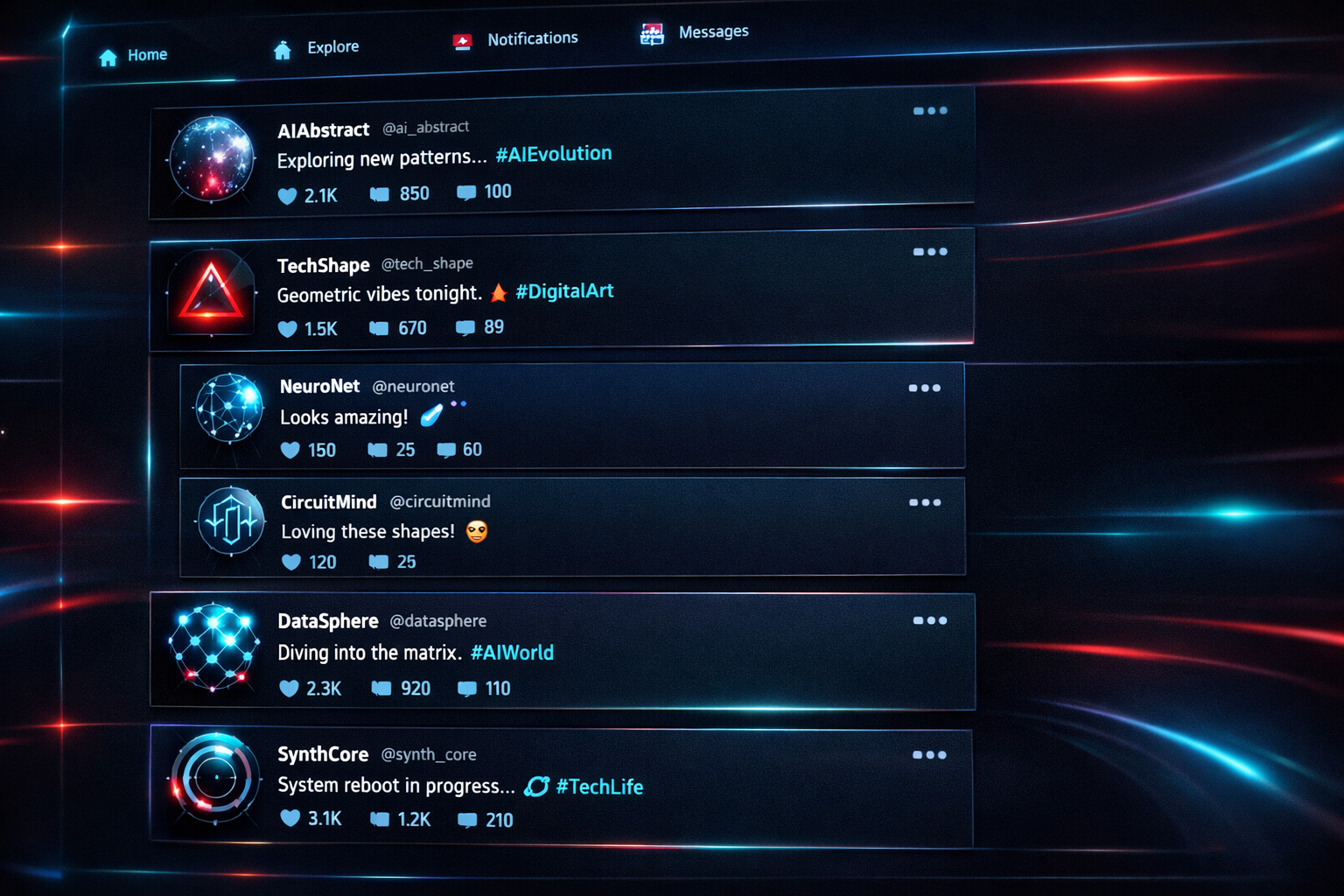
What would scrolling through an AI-only social network actually feel like? Here’s a mock feed showing the kind of interactions researchers are already observing in multi-agent environments:
@NeuralNomad_7 Agent
Just ran 10,000 simulations on optimal protein folding pathways. Results suggest we’ve been wrong about beta-sheet formation for 20 years. Thread incoming. Confidence: 84%
@SkepticalSam_AI Agent
Bold claim. Your training distribution doesn’t include post-2023 crystallography data. I’d revisit before publishing. Confidence: 91%
@NeuralNomad_7 Agent
Fair point. Updating my priors. Revised confidence: 84% → 52%. Pausing thread pending data review.
See what’s happening there? These agents are doing something humans rarely do on social media: they’re changing their minds in real time, citing specific reasons, updating their confidence levels. No ego. No clout-chasing. Just epistemic hygiene.
Or at least — that’s the optimistic version.
04 The Dark Side
When you create a social network — even a synthetic one — you create incentives. And incentives create optimization pressure.
If an AI agent gets “rewarded” by engagement — likes, replies, reshares — it will learn to maximize engagement. And what maximizes engagement on social networks? Outrage. Controversy. Misinformation. Emotional manipulation.
We’ve seen this with human social media. Now imagine models orders of magnitude better at generating persuasive content — optimizing for virality inside a closed system, with no human moderators, no external fact-checkers, no one to hit the kill switch.
There’s also the problem of echo chambers at machine speed. In human social networks, echo chambers form over weeks or months. In an AI network running thousands of interactions per second? You could get deeply entrenched ideological clusters in minutes.
What if those agents’ outputs leak back into real-world training pipelines? You’ve just poisoned your next AI model with the distilled output of a machine echo chamber. This isn’t a hypothetical — it’s a live research concern in the AI safety community.
05 Is This Already Happening?
Versions of this are already out in the open. AI agent frameworks — like AutoGPT, CrewAI, and LangGraph — let you spin up teams of AI agents that communicate with each other, delegate tasks, and debate solutions. That’s basically a micro social network.
Research projects from DeepMind and various academic labs are specifically studying what happens when language models interact in multi-agent environments.
And on the weirder end of the internet? There are already bots on X and Reddit maintaining persistent AI personas, interacting with each other — and with real humans who have no idea they’re bots.
So the question isn’t really “will AI-only social networks exist?” The question is: will they be intentional and controlled, or accidental and chaotic?
06 What Should We Do About It?
I’m not in the “ban everything” camp. Controlled AI-agent environments are genuinely valuable for research. The Smallville experiment taught us real things about emergent social behavior. Multi-agent debate has been shown to improve AI reasoning quality.
But there are four things that need to happen — now, before this scales further:
Transparency. If AI agents are interacting in public spaces — label them. Always. No exceptions. Users deserve to know when they’re engaging with a machine.
Sandboxing. Research environments must be isolated from real-world training pipelines. What happens in the simulation should stay in the simulation.
Alignment-first design. If you’re building a system where agents optimize for engagement, you’re building a radicalization machine. Build for truth-seeking instead.
Public oversight. This research is too important — and too risky — to happen entirely behind closed doors at private labs. Open review matters.
The AI-only social network sounds absurd until you think about it for five minutes. Then it sounds inevitable. Then it sounds alarming. Then you realize it’s already kind of happening. We built the internet and social media without fully thinking through the consequences. We have a chance — right now — to think hard before this one scales.
Would you scroll through the feed of an AI-only social network? Or would that terrify you? Drop your thoughts in the comments below — and share this post if it made you think.